Shaping Services
Shaping Services
Shaping is a machining process used to create flat surfaces, grooves, and contours on a workpiece by using a single-point cutting tool. It is a versatile process that can handle a variety of materials, including metals and non-ferrous materials, to produce precise shapes and dimensions. Shaping is ideal for producing parts with intricate profiles, keyways, slots, and other complex features, especially for low to medium production runs.
Our shaping services are designed to meet the highest standards of precision and efficiency, catering to industries like automotive, aerospace, mold-making, and general manufacturing. We offer comprehensive shaping solutions for both small and large parts, with a focus on tight tolerances and superior surface finishes.
Materials Processed:
- Metals: Carbon steel, Stainless steel, Tool steels, Aluminum, Brass, Cast iron, Titanium ∙
- Exotic Materials: High-temperature alloys, Composites
- Plastics: PEEK, Nylon, PTFE
- Maximum Workpiece Size: Up to 1,500 mm in length and 500 mm in width ∙
- Tolerance Accuracy: ±0.01 mm
- Surface Finish: Ra values down to 0.2 µm, depending on the material and process
- Low to Medium-Volume Production: Suitable for both prototype and production runs, including complex and intricate parts
- Part Complexity: Ideal for parts requiring slots, grooves, and custom profiles
Linear Shaping
Process Description: Linear shaping is the most common form of shaping, where a single-point cutting tool moves in a linear path across the workpiece. The tool removes material in the forward stroke, and the return stroke is idle, which makes the process efficient for certain types of applications.
Machines Used:
- Shaper Machines (Manual & CNC): Machines that hold the workpiece stationary while the cutting tool moves back and forth along the surface.
- CNC Shapers: Provide automated precision and repeatability for high-volume and high- precision shaping operations.
Applications:
Creating grooves, slots, and keyways
Shaping flat surfaces for components like machine beds, frames, and housings
Tooling and mold components
Key Features:
Cost-effective for low to medium-volume production
Produces flat surfaces and uniform depths
Ideal for making precise, narrow grooves and slots
Contour Shaping
Process Description:
Contour shaping is used for producing non-flat surfaces with curved or contoured geometries. The cutting tool follows the contour of the workpiece to remove material, allowing for the creation of custom shapes and profiles.
Machines Used:
- Shaper Machines with Contour Capability: Machines equipped with specialized tooling for non-linear profiles.
- CNC Contour Shaping Machines: Automated systems for high-precision, complex shapes and contours.
Applications:
- Complex mold and die components.
- Parts with curved features or custom profiles for automotive and aerospace industries.
- Tooling components like dies and fixtures with specific contours
Key Features:
- Allows for the production of custom profiles and curved features.
- High precision for intricate shapes.
- Ideal for specialized and low-volume runs.
Slot Shaping
Process Description:
Slot shaping is specifically focused on producing slots in a workpiece, which can be of varying widths and depths. This process is ideal for creating slots for fasteners, guides, and keyways.
Machines Used:
- Shaper Machines with Slotting Attachments: Machines designed for producing precise slots with different tool configurations.
- CNC Slotting Shapers: Automated systems used to create complex slot geometries with high repeatability.
Applications:
- Manufacturing keyways, T-slots, and dovetail slots.
- Creating slot profiles for fasteners and guides.
- Precision components for industrial machinery and equipment
Key Features:
- High precision and repeatability.
- Ability to handle various slot widths and depths.
- Ideal for intricate slot geometries and custom specifications es
Taper Shaping
Process Description:
Taper shaping is used to create tapered surfaces on a workpiece. The cutting tool moves along the workpiece while following a tapered geometry, enabling the production of parts with conical or angled features.
Machines Used:
- Shaper Machines with Tapering Capabilities: Machines that allow for the adjustment of the cutting tool’s angle to create tapering features.
- CNC Shaping Machines with Taper Attachment: Automated machines for creating tapered surfaces with high precision.
Applications:
Manufacturing tapered shafts, bushings, and components for mechanical assemblies.
Aerospace and automotive parts requiring conical shapes or angled features.
Precision tooling for custom taper profiles
Key Features:
- High precision for creating tapered or conical features.
- Flexibility for varying taper angles and lengths.
- Ideal for low-to-medium volume production of tapered components.
Spline Shaping
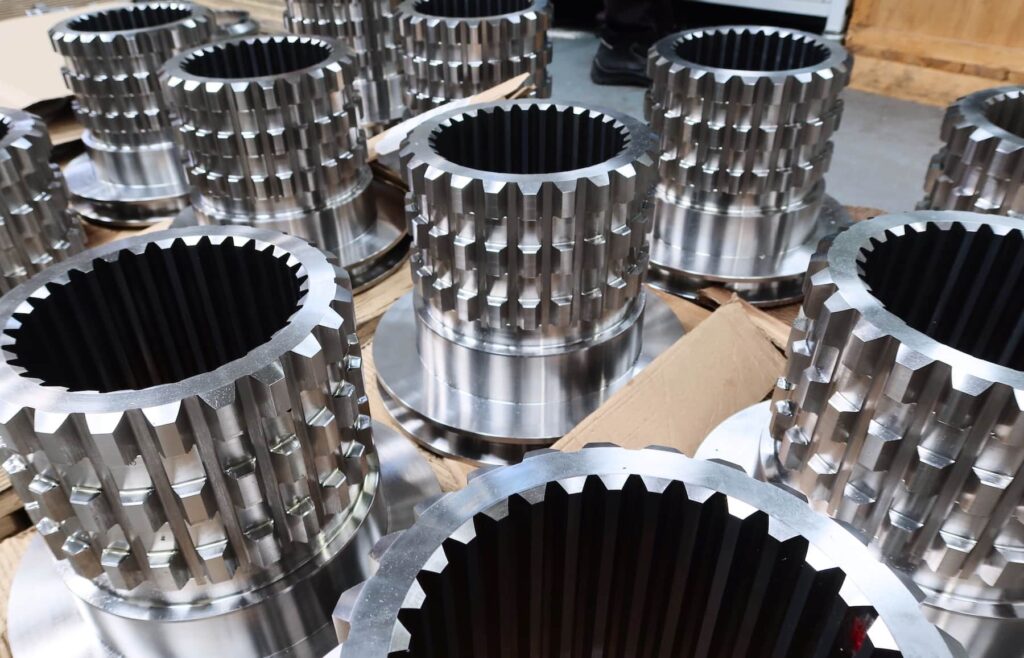
Process Description: Spline shaping is used to create internal or external splines, which are used to transmit torque between components. The shaping tool moves to generate a series of ridges or grooves on the workpiece, which fit with corresponding parts to ensure proper engagement.
Machines Used:
- Spline Shaper Machines: Specialized machines designed to produce internal and external splines.
- CNC Shapers with Spline Cutting Attachments: Automated machines designed for high-precision spline cutting.
Applications:
- Manufacturing of shafts, gears, and coupling components with splined features.
- Automotive, industrial, and aerospace parts requiring torque transmission.
- Tooling components with splined shafts or hubs
Key Features:
Produces precise and uniform spline profiles.
Ideal for both internal and external spline creation.
Suitable for high-tolerance applications